As a professional content creator, I will produce a high-quality, well-structured, and in-depth formal article based on the reference materials and images provided.
Gold Price Returns to $4,120: In-depth Analysis of the Gold Market Amidst Safe-Haven Wave and Macro Gaming
Keywords: International Gold Price, Spot Gold, Safe-Haven Assets, Geopolitical Risks, Fed Policy, Technical Analysis
[Introduction]
During Wednesday's Asian trading session, the international gold market regained upward momentum. After a brief pullback the previous trading day, spot gold (XAU/USD) rebounded strongly to around $4,120. The core driving force behind this rise stems from a sharp deterioration in global risk sentiment and renewed geopolitical tensions. As market optimism about the economic outlook is replaced by uncertainty, investors' attention turns once again to gold, the traditional "safe haven." This fluctuation in gold prices is by no means simple market noise, but rather another strategic choice by global capital between "risk" and "opportunity." This article will comprehensively analyze and forecast this round of gold price increases from multiple dimensions, including geopolitical risks, macro policies, market sentiment, and technical aspects.
I. The Return of Risk Aversion: Why Is Gold Favored Amidst Volatility?
Gold tested the $4,000 psychological level during Tuesday's pullback, but quickly attracted substantial buying, pushing prices to rebound swiftly. This strong "buy-on-dips" momentum reveals a core feature of the current market: the demand for safe-haven asset allocation remains robust, and every price decline becomes an opportunity for bulls to reposition.
1.1 Escalating Geopolitical Risks: Middle East Situation Becomes a New Storm Center
The most direct catalyst for this round of gold price increases is undoubtedly the renewed escalation of geopolitical tensions in the Middle East. The tough confrontation between the United States and Iran is evolving from diplomatic gaming to substantial military conflict. The U.S. Central Command's recent sustained actions against Iran-linked targets, coupled with Iran's strong statements about expanding countermeasures, are posing unprecedented threats to global energy supply lines.

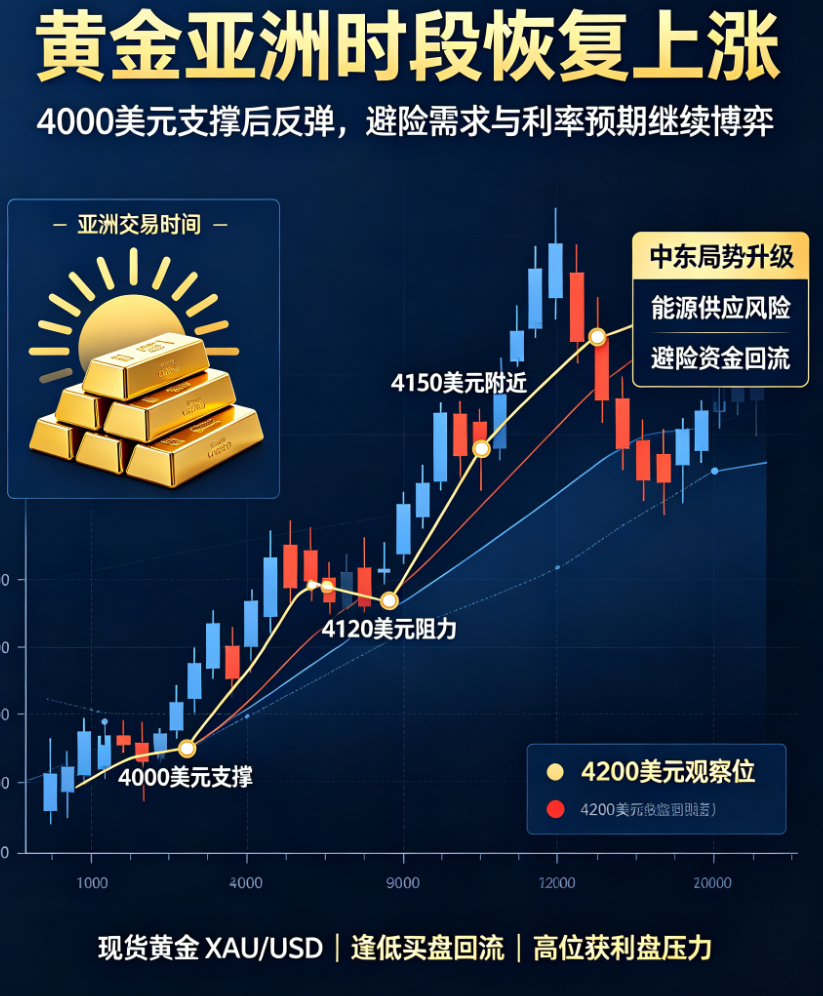
Figure caption: The recent gold price trend shows a clear positive correlation with the Middle East geopolitical risk index, indicating the market's high sensitivity to conflict escalation.
The deterioration of this situation is not just a news story; it directly impacts the stability of global supply chains. The market fears that if a larger-scale conflict breaks out in the Middle East or maritime transportation is restricted, global crude oil supply will face a huge gap. Gold, as an asset for hedging global risks and financial turmoil, naturally becomes the preferred "Noah's Ark" for capital. For investors, when the economic lifeline of energy supply is threatened, any price pullback seems insignificant, and the instinct to protect asset safety drives them back into the gold market.
1.2 Emotion-Driven Rather Than News-Driven: A Collective "De-Risking" Action
Ewa Manthey, a commodity strategist at ING, offers a representative perspective: "The current gold rise is more like buy-on-dips than a direct response to new news." This statement precisely captures the essence of this round of market movement—it is not driven by a single, sudden, significant positive event, but by a renewed deterioration in market risk appetite after a brief recovery.
This indicates that while investors remain confident in gold's long-term allocation value, their short-term trading logic has been completely swayed by sentiment. When the global "risk-return" balance tilts toward "risk," institutional investors' fund management systems automatically initiate "de-risking" procedures, reducing holdings in risk assets like stocks and increasing holdings in safe-haven assets like gold and U.S. Treasuries. Therefore, what we see on the gold price chart is precisely the repeated manifestation of this collective risk-averse behavior.
II. Macro Gaming: The Inflation Specter and the Fed's Rate Puzzle
Beyond the immediate impact of geopolitics, expectations of macroeconomic policies, particularly the Fed's interest rate path, are another key variable determining gold's medium-term trend.
2.1 The Hidden Concern of a Resurgent Energy Inflation
The tension in the Middle East directly pushes up global energy prices. If crude oil prices continue to surge due to supply risks, inflation pressures worldwide will rekindle. Previously, the market had lowered expectations for further Fed rate hikes due to signs of easing U.S. inflation data, and even began betting on rate cuts. However, the geopolitical "black swan" is attempting to rewrite this script.
If rising energy costs are transmitted to core inflation, central banks, especially the Fed, will face a dilemma: continue tolerating high inflation risks to nurture the economy, or further tighten monetary policy to curb inflation. For gold, this constitutes a "double benefit": on one hand, rising inflation expectations themselves enhance gold's appeal as a store of value; on the other hand, if the market expects the Fed to delay or reverse accommodative policies due to inflation pressures, the purchasing power of the dollar will be questioned, further pushing up gold prices.
2.2 The Fed's Ruler and Sword: High-Rate Suppression and Market Expectation Gaming
The Fed's interest rate path has always been a sword hanging over gold bulls. Since gold itself does not generate interest income, when the market expects rates to remain high, the opportunity cost of holding gold increases significantly, which will curb speculative demand.
However, the market is currently weighing which force is stronger: weak economic data or escalating geopolitical risks. The recent decline in U.S. inflation data has convinced some traders to reduce the probability of a July rate hike, but the possibility of at least one rate adjustment before the end of the year remains. This uncertainty causes gold prices to form a highly volatile consolidation pattern rather than a unilateral trend during the rebound.
Additionally, the dollar's trend is crucial. If the Middle East situation triggers a panic inflow of global capital into the dollar, forming a "dollar buying spree," gold may come under pressure due to dollar strength. However, if the market pays more attention to geopolitical risks and inflation uncertainty, gold and the dollar may show a "seesaw" effect, potentially gaining stronger upward momentum amid a weaker dollar.
III. Technical Chart: Evolution from "Consolidation" to "Uptrend"
The market's language is ultimately reflected in the candlestick chart. From a technical analysis perspective, gold's medium-to-long-term uptrend structure remains intact, while the short term has turned stronger after completing a repair.
3.1 Daily Chart: Bullish Foundation Still Exists, Resistance Level Yet to Break
On the daily timeframe, spot gold found strong support near the psychological level of $4,000, which also coincides with the 38.2% Fibonacci retracement level of the previous uptrend. The price has stabilized above the main moving average system (e.g., 20-day and 50-day MAs), indicating that medium-to-long-term bullish momentum still dominates.
Previously, the MACD indicator showed signs of slowing momentum, forming a "bearish divergence" signal. However, with the recent inflow of safe-haven funds, the gap between the fast and slow lines is widening again, and bullish strength is recovering. The key resistance above lies in the $4,150 area, a dense trading zone formed by previous highs. If it can break through effectively with volume, it means the upside space will open, and the next target will point to $4,200 or even higher. On the downside, the $4,000 psychological level remains the first solid defense, while the $3,960 area below is a key bull-bear boundary.
Conclusion: The daily trend leans toward a choppy uptrend, but short-term caution is needed for technical pullbacks caused by profit-taking.
3.2 4-Hour Cycle: Short-Term Momentum Improves, Bulls Take the Initiative
The 4-hour chart reflects a shorter-term gaming process. After touching around $4,000, gold experienced a beautiful "V-shaped" reversal, completing a technical repair and forming a short-term oscillation rebound structure. The moving average system (e.g., MA5, MA10) has started to turn upward, showing a tendency to form a golden cross, indicating that short-term buying is strengthening again.
The RSI indicator has recovered from a low (near 30) to above the 50 midline, showing a significant improvement in short-term momentum. It has not yet entered the overbought zone above 70, meaning there is still room for bullish momentum to play out. On the 4-hour level, the key signal is whether the price can stand and hold above $4,150. If it breaks through, the short term will strengthen further; if it fails to break and pulls back, breaking below the $4,040 support level below, it may retest the $4,000 support.
In terms of trading strategy, the current 4-hour chart shows bulls have an advantage, but traders still need to stay cautious, as the market is highly dependent on real-time changes in geopolitical risk news, and any unexpected events could alter the short-term technical pattern.
IV. Conclusion and Outlook: Gold's Next Move
In summary, the current gold market is in a complex game between "explosive safe-haven demand" and "monetary policy expectation suppression."
Short-Term Outlook: Gold's trend will be highly dependent on the evolution of the Middle East situation. If the conflict escalates or spreads further, gold is expected to quickly break through the $4,150 resistance and challenge $4,200 or even higher. Conversely, if signs of de-escalation emerge, risk aversion will cool, and gold prices may give back gains and retest the $4,000 level.
Medium-Term Outlook: The Fed's interest rate path remains the ceiling determining gold's height. The market is awaiting the Jackson Hole Global Central Bank Symposium in late August for more clues on the future rate path. Inflation data, employment data, and public statements from Fed officials will all be important catalysts for market volatility. Given the stickiness of global inflation and the long-term nature of geopolitical risks, gold's long-term allocation value remains strong.
Advice to Investors: In the current high-volatility environment, investors should avoid blindly chasing highs or panic selling. It is recommended to adopt a strategy of "buying on dips and entering in batches," focusing on the support level near $4,000 and the breakout signal above $4,150. At the same time, geopolitical factors should be given top priority, closely tracking the Middle East situation, energy prices, and Fed policy moves. Gold, the eternal "King of Safe Havens," is destined to play an even more critical role in the final months of 2026.