Okay, please see the professional article created based on the reference content and images you provided.
Gold Price Resurgence: Structural Game in Shenzhen Shuibei and Global Gold Markets
Keywords: Gold market, Shenzhen Shuibei, gold price fluctuation, consumer psychology, medium to long-term investment
[Introduction]
"As soon as gold prices rebound a little, market sentiment immediately improves." Manager Huang, who runs a gold jewelry business in Shenzhen Shuibei, sighed as he tidied the counter. This statement precisely depicts a subtle reality of the current gold market: there is a nearly immediate positive correlation between gold prices and market sentiment. Recently, boosted by both heightened geopolitical tensions in the Middle East and a weakening US dollar index, international gold prices once strongly returned to the $4,100 per ounce mark, and market confidence has also rebounded significantly. However, market volatility remains; as of tonight, international gold prices have pulled back, falling below $4,060 at the time of writing. This volatile market not only tests investors' psychology but also reflects the unique operational logic of gold as a global asset under a complex macroeconomic background.

[Main Text]
I. End Consumer Market: Buy on Rally, Not on Dip; Sentiment Returns to Physical
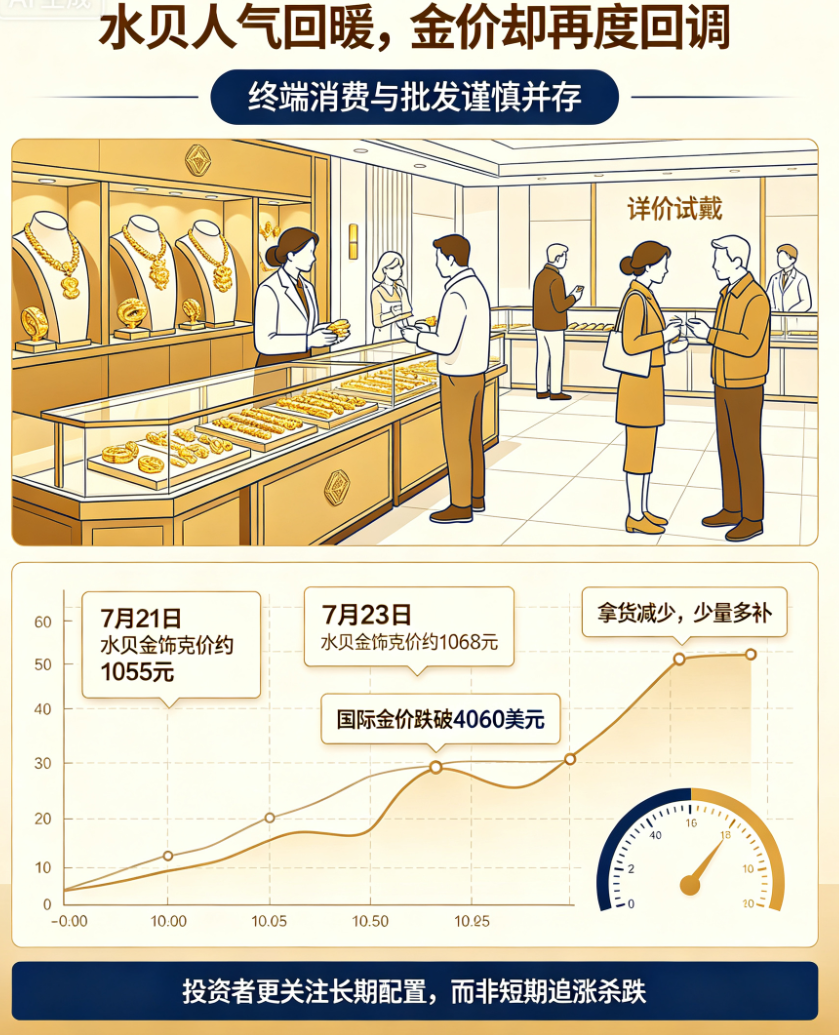
On July 23, reporters visited the largest gold jewelry industry cluster in China – the Shenzhen Shuibei market. Even though it was a working day, multiple markets were bustling with consumers inquiring and trying on jewelry, a stark contrast to the period when gold prices were low. "In recent days, market sentiment has become markedly stronger; ordinary consumers still buy on the rally, not on the dip," Manager Huang told reporters. If gold prices can continue to recover, the weekend market will be 'packed with people.' He pointed out that recently, international gold prices and Shuibei gold jewelry prices have risen consecutively, with the per-gram price climbing from about 1,055 yuan on July 21 to around 1,068 yuan on July 23.
However, the shift in consumer behavior is not accidental. Previously, due to the sustained volatile decline in gold prices, the market was dominated by a wait-and-see sentiment. Although gold prices no longer experienced drastic ups and downs, the continuous decline significantly affected consumers' psychological expectations, leading to a decrease in foot traffic to jewelry stores and low transaction levels. This 'buy on rally, not on dip' consumer psychology is especially typical in the gold market, reflecting the high sensitivity of public investment and consumption decisions to short-term price trends.
II. Midstream Wholesale Chain: Caution Persists, Flexible Replenishment Becomes Mainstream
In contrast to the enthusiasm of end consumers, the cautious sentiment in the midstream gold wholesale segment has not completely dissipated. A gold wholesale merchant in Shuibei reported to reporters that clients have significantly reduced their order quantities recently, generally adopting a 'small quantity, frequent replenishment' strategy. "Probably in the past they would take one or two catties at a time, now it's less than half a catty." This change clearly indicates that wholesalers are still doubtful about the subsequent gold price trend. They worry that the market may suddenly fluctuate significantly, leading to a surge in inventory risk. This shift from 'stockpiling' to 'fast turnover' is precisely the market's direct response to increased uncertainty.
III. Investment Logic Review: Balancing Long-Term Value and Asset Allocation
Being on the front line of the market, Manager Huang has witnessed too many investors swept away by short-term market fluctuations. Many of his friends who followed the trend into the market have experienced considerable unrealized losses during the previous gold price pullback. "Investment requires your own judgment; first, look at the investment value from a long-term perspective, rather than just buying and selling based on the heat of precious metal investment. Second, control the amount well." This simple advice reveals the true essence of gold investment.
Wang Lixin, CEO of the World Gold Council China, offered professional advice from a more macro perspective: "If investors consider gold as part of their long-term asset allocation, and it does not affect their daily life or portfolio structure, and the proportion is not high, then they can hold it and observe. Otherwise, if they cannot withstand any minor fluctuation, that is not the normal underlying logic of investing in gold."
IV. Global Economic Perspective: The Resilience of Gold as a Global Asset
Looking back at this year, the international gold market has experienced extreme volatility. At the beginning of the year, gold prices repeatedly hit new highs, but after breaking historical peaks, they fluctuated downward, and even briefly fell below the $4,000 per ounce mark at the end of June. Behind this wave of volatility lies a complex interplay of global macroeconomics, geopolitics, and interest rate policies of major economies.
The World Gold Council's '2026 Global Gold Market Mid-Year Outlook' report points out that gold will enter a critical juncture in the second half of the year. Ankai, CEO of the World Gold Council Americas and Head of Global Research, emphasized: "This year, the gold market has clearly conveyed a signal: gold is truly a global asset. Gold prices reflect macroeconomic and geopolitical dynamics globally, not just in the United States. Interest rates are important, but gold's performance is not driven by a single factor." This year, international gold prices have experienced both pressure and rebound near $4,000 per ounce, mainly supported by endogenous demand from long-term investors in multiple regions. Structural demand from central banks, institutional investors, and consumers worldwide forms the foundation of gold's resilience.
[Conclusion]
The bustling scene at the Shenzhen Shuibei market is a direct reflection of the gold price recovery at the end-consumer level. However, from the caution of wholesalers to the advice of experts, and to the support of global macro structural demand, all reveal the complex multidimensional characteristics of the gold market. While investors pay attention to short-term price fluctuations, they should also deeply understand the value logic of gold as a long-term asset allocation. In a global environment full of uncertainty, gold's safe-haven attributes and long-term investment value are being reassessed by the market in a more rational manner.