Gold Market Ushers in Corrective Rally: In-depth Analysis of Drivers, Misconceptions, and Future Outlook
After a period of sustained consolidation and correction, the international gold market experienced a significant rally during the night session on July 22, with prices quickly breaking through previous resistance levels, attracting widespread market attention. Following the news, investors, consumers, and the general public showed clear divergence: some believed a new upward trend had officially begun, while others considered it merely a sentiment-driven spike. Different groups have different concerns — consumers preparing to buy gold jewelry worry about further price increases, investors in gold ETFs and Shanghai gold futures try to gauge the sustainability of this rebound, and many others, unable to distinguish between international gold prices, domestic raw gold prices, and branded jewelry gold prices, are easily misled by fragmented online quotes.
This article combines real market data from the night session of July 22, the current global macro environment, geopolitical situation, and capital flows to objectively dissect the driving forces behind this round of gold price increases, distinguish between short-term market fluctuation logic and long-term fundamental support, sort out the potential directions of recent domestic and international gold price movements, and review common misconceptions that the public often encounters when dealing with gold. Below is a detailed analysis.
I. Overnight Gold Price Rally: Multiple Factors Converge to Trigger Short-term Correction
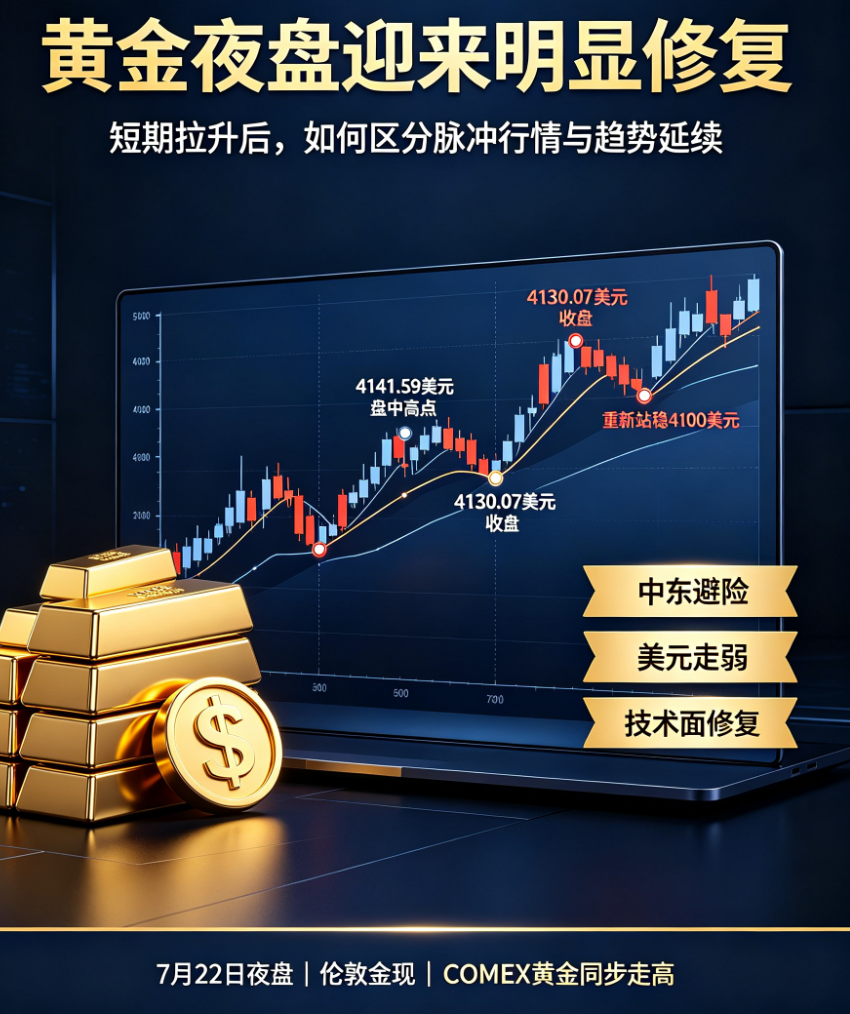
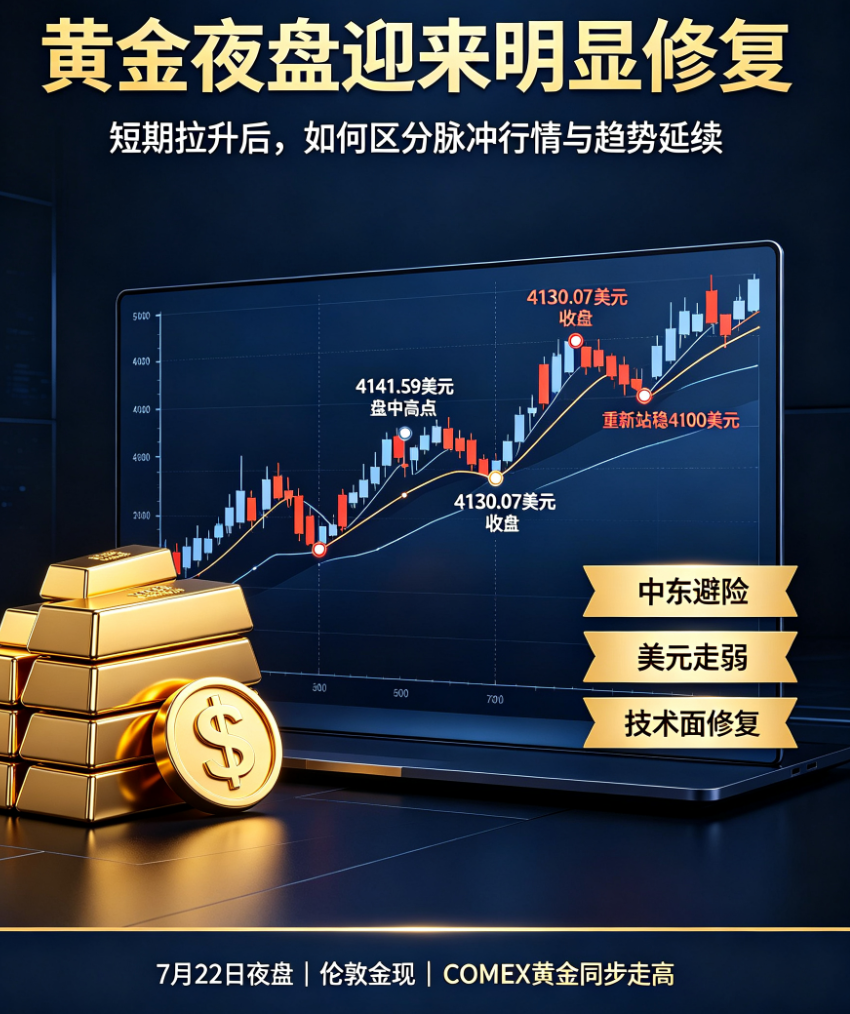
On the evening of July 22, London spot gold and New York COMEX gold rose simultaneously. London spot gold hit an intraday high of $4,141.59 per ounce, while New York spot gold closed at $4,130.07 per ounce, with a daily gain of 1.31%, reclaiming the $4,100 per ounce level and ending a multi-session low-level tug-of-war. This rally was not driven by a single piece of news but was a technical correction formed by multiple conditions.
(1) Rising Geopolitical Uncertainty Spurs Safe-Haven Buying
Red Sea shipping risks have escalated again, with several crude oil tankers adjusting routes, raising concerns that regional conflicts may expand further. During periods of heightened geopolitical risk, some funds allocate gold to hedge tail risks, with short-term capital entering the market collectively, pushing prices up rapidly. However, an objective view is needed: geopolitical-driven safe-haven trends are mostly impulsive in nature. If the situation does not continue to escalate, after speculative funds take profits and exit, gold prices can easily return to the original consolidation range, and it is difficult to sustain a rally solely on geopolitical news.
(2) Phase-Weakening Dollar Index Eases Gold Valuation Pressure
Gold is priced in US dollars. When the dollar declines, the cost for overseas investors to buy gold decreases, attracting additional capital. Meanwhile, the market continues to monitor US economic data, with inflation and employment data marginally weakening, leading to a loosening of expectations that the Fed will maintain high interest rates. As a non-yielding asset, when market expectations of rate cuts rise, the opportunity cost of holding gold decreases, which is positive for gold prices in the medium to long term.
(3) Technical Correction Demand Exists
Prior to this, gold prices underwent a period of sustained correction, with a large accumulation of short positions at lower levels. After prices stabilized, concentrated short covering created passive buying pressure, combined with bargain-hunting funds entering in batches, jointly driving the overnight rally. In simple terms, after consecutive adjustments, a technical correction demand exists – a crucial factor not to be overlooked in this upswing.
(4) Continued Global Central Bank Gold Purchases Provide Long-Term Floor Support
A survey by the World Gold Council shows that over 80% of central banks plan to continue increasing their gold reserves to optimize foreign exchange reserve structures. These funds are long-term strategic allocations and do not trade frequently based on short-term price fluctuations. They provide continued buying support during significant gold price declines, limiting the downside. However, it must be emphasized: long-term central bank purchases providing a floor do not mean short-term prices will only rise. Long-term support can only reduce the risk of a sharp fall, not prevent periodic consolidation adjustments, and cannot be directly equated with this rebound continuing to expand.
II. Understand the Three Types of Gold Prices; Don't Be Confused by Quotes
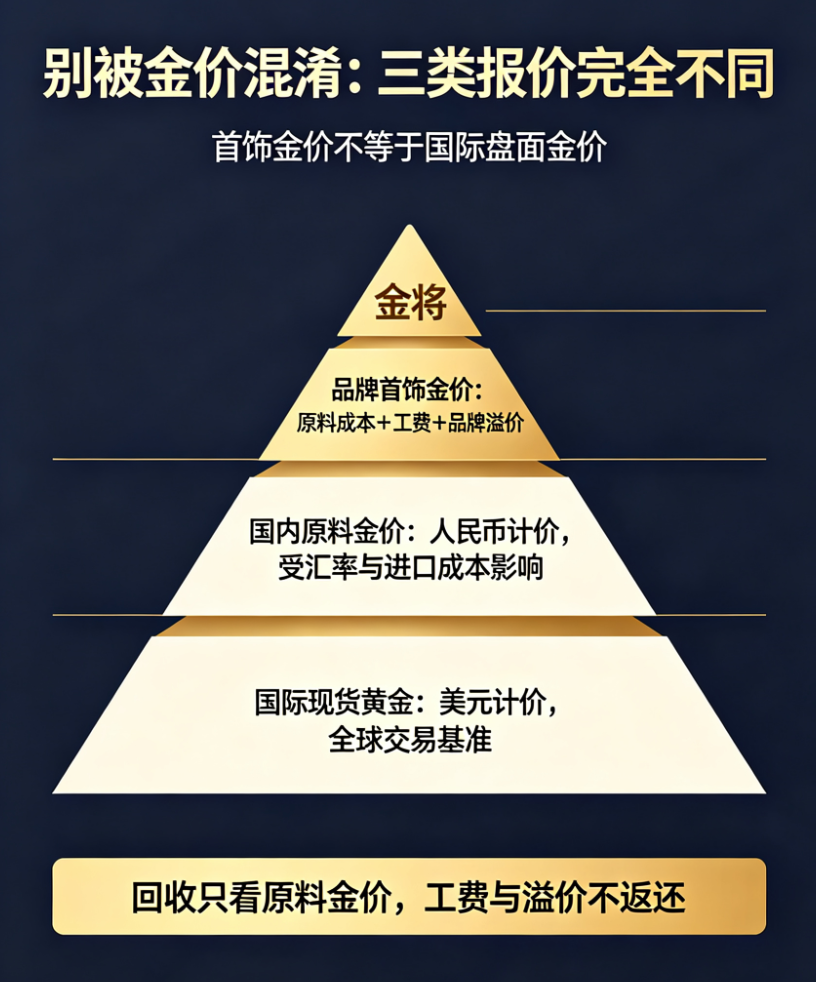
Many people, upon seeing the overnight gold price rise, immediately go to offline jewelry stores to check prices, only to find that the increase in store listed prices does not match the international market gain. The core reason is that there are three completely different gold quotes in the market, and most people have long confused them.
Type 1: International Spot Gold Price
This is the US dollar-denominated gold price in financial news, the benchmark for global gold trading. It trades almost 24/7 and is the most responsive. The rally on the night of July 22 refers to this type of quote.
Type 2: Shanghai Gold Exchange Raw Gold Price and Shanghai Gold Futures Price
Priced in RMB, derived from international gold prices adjusted for exchange rates and import costs, this is the benchmark for domestic gold bars and gold processing enterprises. When international gold prices rise, domestic raw gold prices usually follow, but due to time zone differences in trading hours, there are often cases where the overseas market surges while the domestic morning session sees a small gap up.
Type 3: Retail Prices of Brand Gold Jewelry Stores
Jewelry gold prices are not the same as raw gold prices. Retail price = raw gold cost + processing fee + brand premium + store operating costs. That is, even if international gold prices rise slightly, stores may not immediately adjust prices; conversely, when international gold prices fall, retail jewelry prices often lag. Also, when recycling gold, merchants only calculate based on the raw gold price, and the craftsmanship fees and brand premium paid at purchase are not refunded.
Practical Advice: If buying gold jewelry for weddings or daily wear, prioritize your actual needs and don't base timing solely on short-term price fluctuations. If you want to allocate gold to diversify asset risk, focus on raw gold prices and understand the large value difference between investment gold bars and jewelry gold.
III. Multiple Variables Intertwined: Analysis of Market Evolution Scenarios
After the overnight gold price rally, the domestic gold market will take over the overnight market sentiment. Combining current capital and macro environment, we objectively sort out several possible scenarios, for rational reference only, not as a basis for any transactions.
Favorable Conditions for Continued Rally
- Geopolitical risk aversion continues to ferment;
- US economic data continues to weaken, further reinforcing rate cut expectations;
- Dollar index and real yields on US Treasuries continue to decline;
- Gold ETFs see sustained inflows, stable buying power;
- Domestic physical gold consumption demand recovers in tandem, supporting Shanghai gold prices.
Signals to Watch for Consolidation or Decline
- Overnight rally driven purely by short-term speculative funds, lacking sustained fundamental support;
- Geopolitical tensions ease, safe-haven funds take profits quickly;
- Market revises Fed rate expectations again, extending the period of high interest rates;
- After early morning spike, follow-up buying insufficient, resulting in a "buy the rumor, sell the fact" scenario.
Overall, the probability of a sustained unilateral surge or sharp drop is low. In the short term, the market will likely remain range-bound. The overnight rally repaired previous pessimistic sentiment, but for a sustained trend to emerge, more macro data verification is needed. For ordinary consumers, there is no need to rush in out of anxiety due to one night's rise. For gold investment participants, try not to chase highs for short-term trading, as short-term gold price volatility remains highly uncertain.
IV. Public Participation in Gold: Four Most Common Cognitive Misconceptions
Whenever gold prices experience a significant move, various one-sided views easily emerge in the market. Many people fall into traps due to the following four misconceptions.
Misconception 1: A One-Night Rally Means an Immediate Sustained Surge
A single overnight rally only indicates a change in short-term market sentiment. Looking back at gold trends in recent years, there are countless cases of a one-day spike driven by news, followed by a return to consolidation. A sustainable trend requires a confluence of multiple factors such as interest rates, inflation, capital flows, and supply-demand dynamics. A single rebound is not enough to confirm a trend reversal.
Misconception 2: Gold Is Always a Store of Value; Buying at Any Time Will Not Result in Loss
Gold does have long-term attributes of hedging inflation and preserving purchasing power. However, that does not mean buying at any price level can avoid unrealized losses. If you buy heavily at a cyclical high, subsequent consolidation and adjustments will still lead to short-term paper losses. Value preservation is a result observed over several years; no asset guarantees a profit upon purchase.
Misconception 3: Gold Jewelry Is Suitable for Large-Scale Investment Hoarding
This is the biggest trap for ordinary people. Jewelry gold carries high processing fees and brand premiums; it is essentially a consumer product. Even if raw gold prices rise later, when you want to liquidate, the entire premium is lost. If your goal is asset allocation and risk diversification, you should prioritize standard investment gold bars with lower premiums. Buying jewelry should primarily meet wearing needs.
Misconception 4: Only Focus on International Gold Prices, Ignoring Exchange Rate Impact
Domestic RMB gold prices are derived from international gold prices converted through exchange rates. Sometimes international gold prices rise, but the RMB strengthens simultaneously, so the increase in domestic raw gold prices is limited. Conversely, when international gold prices fall slightly, if the RMB depreciates, the decline in domestic gold prices may be offset. You cannot simply use international market movements to predict domestic jewelry store prices.
V. Observing Gold Market Going Forward: Focus on Five Core Signals
There is no need to stare at every tick; grasping a few key indicators allows for more rational judgment of market evolution.
- Continuously track US inflation and employment economic data: The strength of the data directly changes market expectations for the Fed's interest rate policy, which is the most core medium-term driver of gold prices.
- Monitor the dollar index and 10-year US Treasury real yield changes: These two have a strong negative correlation with gold; sustained increases usually cap gold's upside.
- Pay attention to the direction of geopolitical developments: Focus on whether conflicts continue to escalate to judge if safe-haven sentiment can persist.
- Track global gold ETF holdings changes: Continuous accumulation indicates rising institutional appetite; persistent reduction suggests capital outflow.
- Monitor domestic physical gold consumption demand: Recovering demand during peak seasons provides additional support for domestic gold prices.
For those positioning gold in the medium to long term, don't let a single overnight session disrupt your overall plan. Short-term price fluctuations are driven by sentiment and news, while long-term value depends on the global monetary environment and the pace of central bank gold purchases. Gold is more suitable as a diversification tool in a portfolio, not for ordinary people to make heavy short-term speculative bets.
Conclusion
Overnight gold prices experienced a significant rally, driven by a confluence of factors for short-term repair. We need to objectively distinguish: the short-term rebound is a result of capital and news acting together, while the medium to long-term trend still awaits further macro data verification. To preserve wealth through gold, first clarify your own needs, distinguishing between consumer-oriented gold jewelry and investment gold bars for asset allocation. Don't let short-term market movements sway your emotions and blindly chase highs in purchases or trades. Whether buying gold or participating in gold-related investments, you should reasonably control the amount of funds invested, fully understand the risks of precious metal price volatility, and maintain a rational mindset.
Risk Warning: Geopolitical changes are abrupt, and the sustainability of safe-haven trends is unpredictable; Repeated shifts in Fed monetary policy expectations can cause significant gold price volatility; There are trading time differences between domestic and international gold markets, posing gap risk; Gold jewelry carries high premiums, resulting in discount losses when liquidating; Historical performance does not represent future price movements.