Professional article based on your reference content.
US-Iran Conflict Escalates, Gold Under Pressure at $4,000 Tug-of-War
【Keywords】 US-Iran conflict, gold, $4,000, gold-oil seesaw, rate hike expectations, de-dollarization
Introduction
In July 2026, global financial markets again experienced intense volatility. The sharp escalation of US-Iran geopolitical conflict triggered market panic at first; however, the performance of traditional safe-haven gold was surprising. On July 20, spot gold prices briefly fell below the key integer level of $4,000 per ounce, forming a sharp contrast to the surge in crude oil prices. Behind this phenomenon is an intense contest between the logic of "geopolitical safe-haven" and "interest rate suppression." This article aims to analyze the current tug-of-war pattern in the gold market and discuss the dual logic of short-term pressure and long-term support.
1. Conflict Escalation Lifts Oil, Weighs on Gold
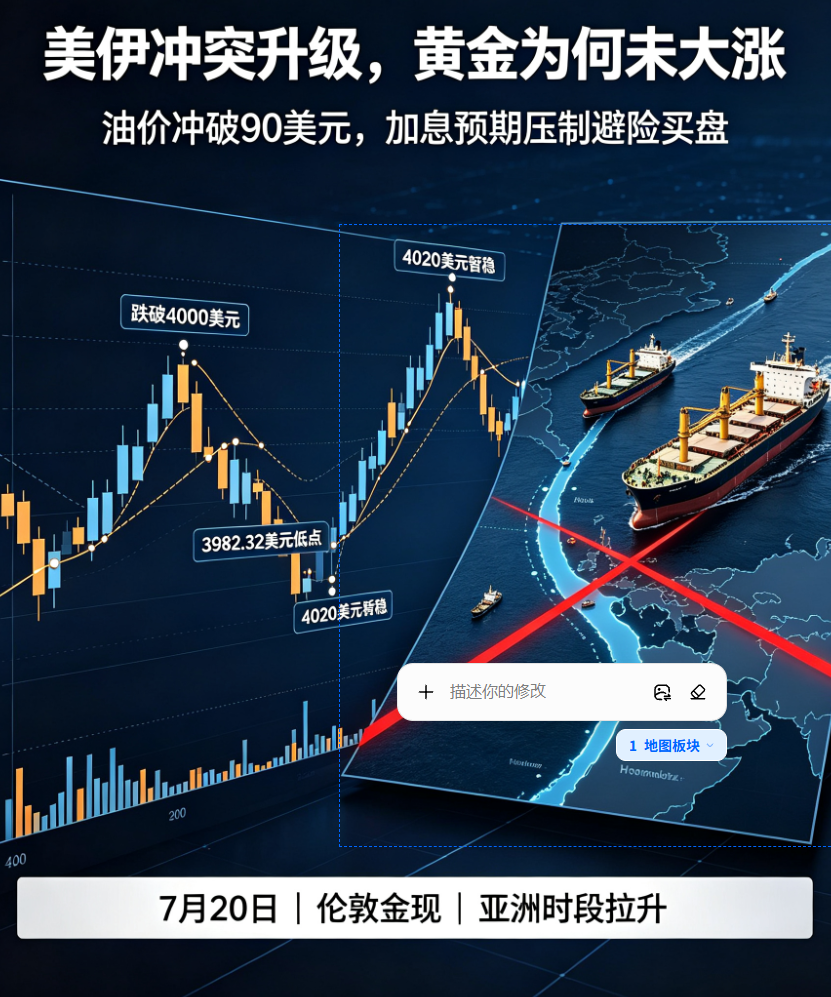
Further escalation of the US-Iran conflict over the weekend became a direct trigger for market volatility. According to Iran's Fars News Agency, traffic through the Strait of Hormuz dropped to zero. This news immediately sent international oil prices above $90 per barrel. However, gold did not rise as traditional theory would expect amid rising risk aversion; instead, it fell under pressure, bottoming out at $3,982.32 per ounce.
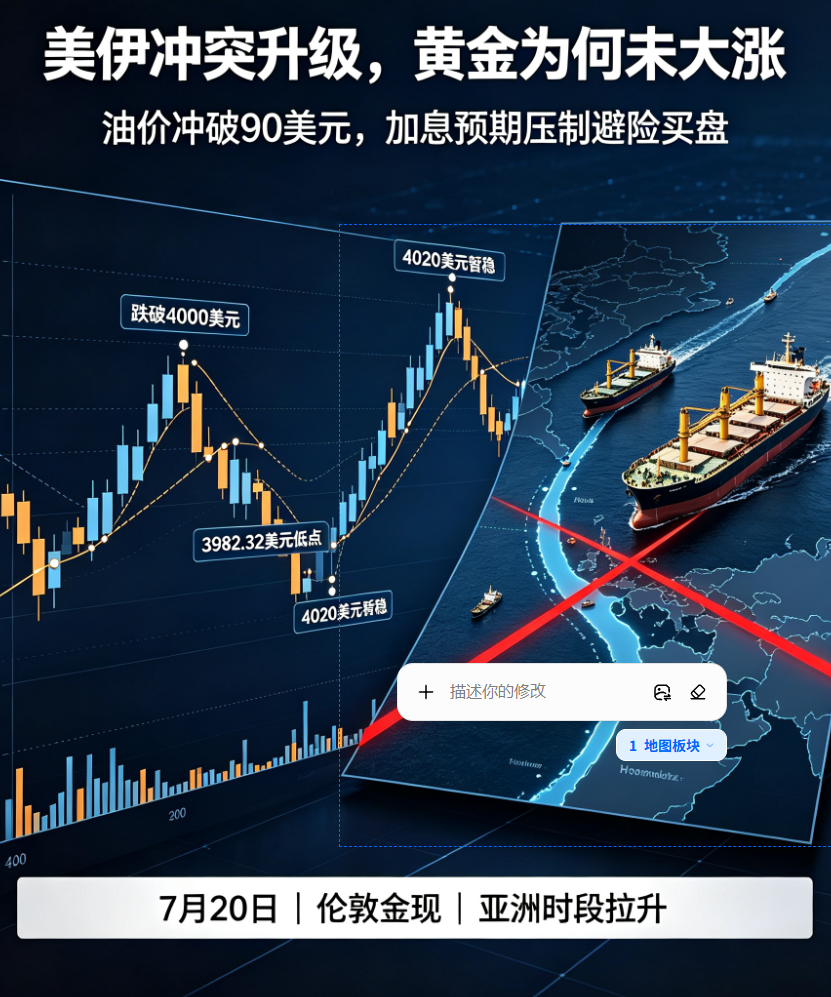
Image caption: Spot gold prices rebounded slightly after hitting a short-term low on July 20, 2026, but remain in a volatile range.
The abnormal phenomenon of "gold weak, oil strong" stems from the shift in dominance of global macro trading logic from "geopolitical safe-haven" to "inflation and rate-hike expectations." Liang Yonghui, Deputy General Manager of Shandong Zhaojin Gold and Silver Refining Co., Ltd., noted: "This round of geopolitical conflict has pushed up oil prices, exacerbating inflation stickiness. The logic of interest rate suppression has temporarily overshadowed geopolitical safe-haven logic. After excessive overdraft of earlier risk premiums, a correction occurred as expectations were realized."
2. Gold-Oil Seesaw Effect: Inflation Expectations Become Key Variable
Since late February 2026, gold and crude oil prices have shown a significant seesaw effect. The transmission chain is clear and direct: Oil price rises -> inflation expectations rise -> Fed rate hike expectations strengthen -> non-interest-bearing asset gold under pressure.
Market concerns about inflation have re-emerged. Although the U.S. June Consumer Price Index (CPI) and core CPI data cooled more than expected, temporarily weakening bets on further Fed rate hikes, the energy price shock triggered by the US-Iran conflict is quickly stoking new fears of inflation stickiness.
From market pricing, CME FedWatch data shows traders now see an 82% probability of a rate hike in December, up from 73% a week earlier. High inflation pressure raises fears that the Fed will maintain a higher interest rate environment for longer, which imposes direct and heavy pressure on gold, an asset that yields no interest.
3. Bulls vs Bears Battle: Strategic Significance of $4,000 Level
In terms of fund flows, bulls and bears are engaged in an intense tug-of-war around the psychologically and technically significant $4,000 per ounce level. According to the latest data from the U.S. Commodity Futures Trading Commission (CFTC), for the week ending July 14, reported long positions in COMEX gold futures increased, but short positions increased even more, leading to a decline in non-commercial net long positions, indicating greater caution among speculative funds at high levels.
Guotai Fund analysis believes that the core logic for gold currently is the battle between "geopolitical inflation" and "rate-cut expectations." The US-Iran conflict boosts oil prices and inflation concerns, strengthening the expectation of maintaining high rates; while the June CPI data cooling more than expected temporarily eased rate hike pressure. These two forces repeatedly tug, leading gold prices to oscillate in the range of $3,959 to $4,104. The gain or loss of the $4,000 level is not only a technical support vs resistance battle but also reflects the market's phase judgment of the two core logic forces above.
4. Divergent Outlook: Short-Term Pressure vs Long-Term Support
Regarding future direction, professional institutions hold divergent views but generally agree that the short-term correction is not over yet.
Bank of America analyst Paul Ciana stated in a report that gold may remain under pressure from August to September, and prices may eventually find a solid bottom only after testing support around $3,600 per ounce. He pointed out that the duration of the correction is relatively short compared to the previous rally period. Nevertheless, BofA proposed a phased buying strategy, recommending moderate position building below $4,000 and maintaining a long-term optimistic outlook for gold to reach $6,000 by 2027.
From a medium- to long-term perspective, the supporting logic for gold prices remains unshaken. Guotai Fund believes that medium- and long-term factors such as fiscal deficits, geopolitical tensions, and currency concerns continue to support gold demand. Liang Yonghui further emphasized that de-dollarization is the core narrative supporting the long-term trend of gold this cycle, which is not contradictory to short-term dollar strength. "Dollar strength is a short-term cyclical fluctuation, while de-dollarization is a long-term structural trend of over ten years." Central banks around the world continue to adjust reserve asset structures at a strategic level, gradually reducing dollar dependency, providing a solid long-term foundation for gold prices.
5. Policy Vacuum Intertwined with Geopolitical Risk Enter the Game Phase
The market generally believes that a true turning point in the future requires confirmation of two key signals: first, whether U.S. inflation data can continue to improve to weaken Fed rate hike expectations; second, whether energy prices (especially oil) will retreat from highs to ease inflation pressure.
Goldman Sachs Chief Economist Jan Hatzius pointed out that inflation improvement has largely eliminated the possibility of a rate hike at the July FOMC meeting. Until these two turning signals are clear, the gold market will be in a game phase where a policy vacuum interweaves with geopolitical risks. Meng Wenrui, Chief Investment Officer at Amundi Asset Management, suggested that in a market dominated by geopolitics and inflation, the share of physical assets, gold, and commodities in hedging portfolios should be increased to deal with uncertainty.
Conclusion
In summary, the gold market is currently at a complex and contradictory crossroads. In the short term, high oil prices triggered by the US-Iran conflict and stubborn inflation expectations force gold to bear relatively strong interest rate suppression, and the battle for the $4,000 level may continue. In the medium term, market focus will shift back to changes in U.S. inflation data and the Fed's policy path.
However, over the long term, the core narratives supporting gold's rise — de-dollarization trends, global geopolitical turmoil, and central banks' strategic gold purchases — remain intact. Therefore, the current adjustment in the gold market is more seen as a technical correction and short-term emotional venting within a long-term bull market. For investors, grasping long-term certainty amid short-term uncertainty may be the key strategy to navigate the current "policy vacuum" and "price oscillation" period.