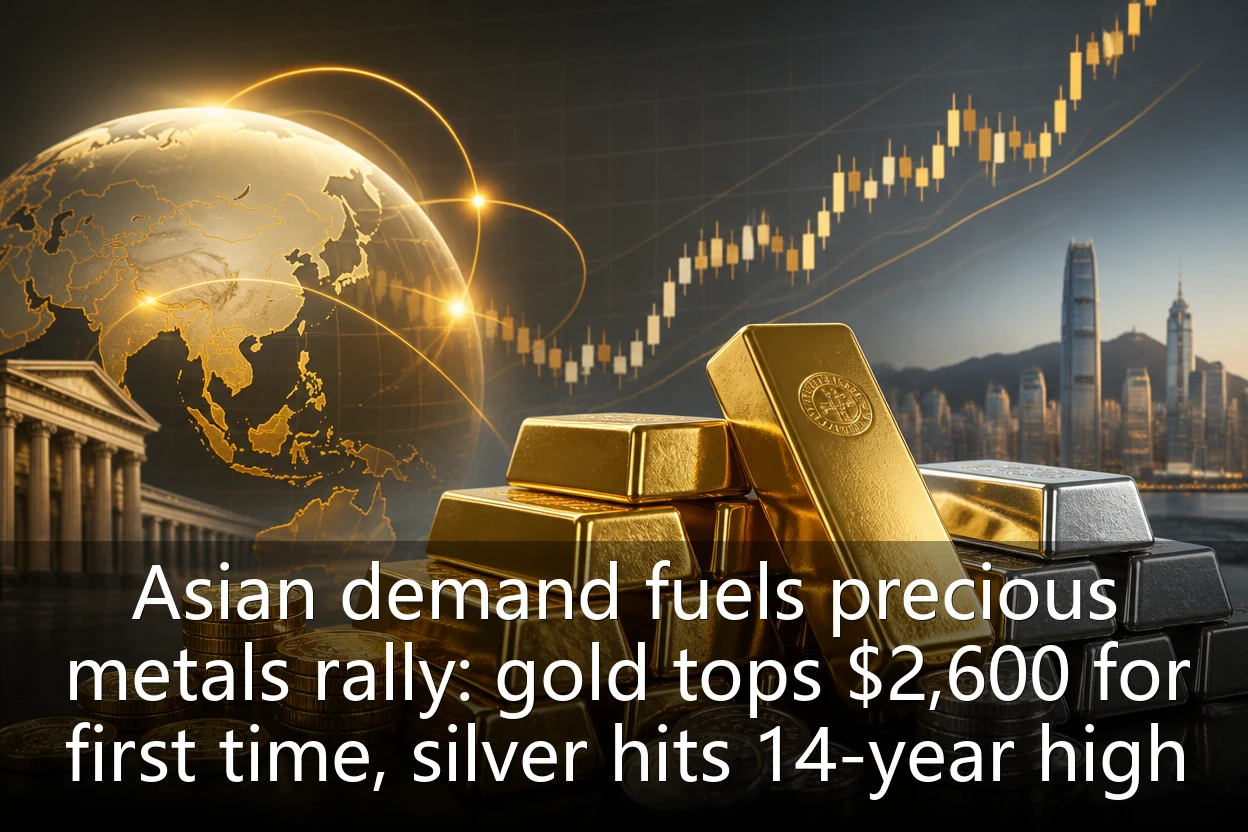
During the Asian trading session on August 1, 2026, the precious metals market witnessed a historic moment. International spot gold broke through the key psychological level of $2,600 per ounce, reaching a high of $2,624.5 per ounce and setting a record high. Spot silver also performed strongly, rising to $41.2 per ounce, a 14-year high since 2012. This powerful rally was ignited by the combined force of global macroeconomic conditions and regional demand.
Gold breaks above $2,600: technical and fundamental drivers align
In early Asian trading today, as the U.S. dollar index dipped to around 94.2 and the real yield on 10-year U.S. Treasuries fell to -0.65%, gold buying surged. Trading volume in the main COMEX gold futures contract expanded 30% above the recent average, with ample market liquidity. Technical analysis shows gold has broken above the upper edge of the uptrend channel formed since 2024, and the MACD indicator has formed a golden cross above the zero line, indicating strong bullish momentum. However, the Relative Strength Index (RSI) has entered overbought territory, suggesting the possibility of a short-term pullback.
On the fundamental side, the Federal Reserve kept rates unchanged in the 4.00%-4.25% range for a fourth consecutive meeting at the July 30 FOMC gathering, but the policy statement removed earlier language about the possibility of further rate hikes. The market interpreted this as a strongly dovish signal, and swap contracts now imply an 85% probability of a rate cut in September. This expectation directly weakened the appeal of the dollar and U.S. bond yields, creating a favorable environment for precious metals.
Asian demand becomes key driver amid robust physical buying
The latest Global Gold Demand Trends Report released today by the World Gold Council shows that total global gold demand reached 1,400 tons in Q2 2026, up 28% year on year, the highest for the period in nearly a decade. Asia stood out notably: China and India, the two largest gold-consuming countries, maintained their resilience in buying on strength, with Q2 gold jewelry consumption rising 15% and 22% year on year, respectively.
Data released by the China Gold Association the same day show that domestic gold product sales reached 460 tons in H1, up 12% year on year, with investment products such as gold bars and coins up 18%. A person in charge of a Shanghai Gold Exchange member institution told reporters: “Consumers and investors have deepened their understanding of gold’s long-term value, and higher prices have actually spurred the willingness to allocate on dips.” In addition, gold denominated in renminbi has performed even more strongly, with the latest quote for SGE gold T+D reaching 612 yuan per gram, up 18% since the start of the year.
- Spot gold: closed at $2,620.3 per ounce, up 0.8%
- Spot silver: closed at $41.0 per ounce, up 2.1%
- U.S. dollar index: down 0.3% to 94.2
- 10-year U.S. Treasury real yield: fell to -0.65%
Central bank buying and ETF inflows provide dual support
The report also shows that global central banks net purchased 183 tons of gold in Q2, up 35% year on year. The Reserve Bank of India led the buying with 42 tons added during the quarter, followed by the Monetary Authority of Singapore with 28 tons. Although central bank buying slowed slightly quarter on quarter versus Q1, it remained in net purchase territory for the 18th consecutive quarter. Analysts point out that amid de-dollarization and prolonged geopolitical risks, there remains ample room for central banks, especially those in emerging markets, to increase gold reserve allocations.
Meanwhile, demand for precious metals exchange-traded products (ETPs) continued to recover. Holdings in SPDR Gold Shares, the world’s largest gold ETF, increased by 8.4 tons on July 31, bringing total holdings to 1,480 tons, the highest since 2022. Data from fund flow monitor EPFR show that in the week through July 30, precious metals-themed funds attracted cumulative net inflows of $5.4 billion, marking the eighth consecutive week of positive inflows, with Asian regional ETFs contributing about 40% of the increase.
Silver shines: industrial and financial attributes combine
Compared with gold, silver recorded a larger gain today, showing stronger momentum. Spot silver surged as much as 2.4% before closing up 2.1% at $41.0 per ounce, compressing the gold/silver ratio to around 64:1. Silver’s standout performance is underpinned by two factors: first, on the financial side, it also benefits from rate-cut expectations, as lower real rates reduce holding costs; second, industrial demand provides intrinsic support.
With global photovoltaic installations continuing to beat expectations, demand for front-side and back-side silver paste in solar cells has surged. Industry research firm Bernreuter Research forecasts that global silver use in photovoltaics will reach 180 million ounces in 2026, up 25% year on year, raising its share of total silver demand further to 28%. In addition, growing use of electronic components in 5G communications equipment and new energy vehicles has opened new demand space for silver. Silver inventories on the London Metal Exchange (LME) have fallen for five consecutive months, now standing at just 28,000 tons, down 12% since the start of the year, strengthening supply-side support for silver prices.
Outlook: long-term bull logic intact, but watch for short-term overbought conditions
Several institutions are optimistic about the future direction of the precious metals market. In its latest report, Goldman Sachs analysts raised their Q3 2026 gold price target to $2,700 per ounce, arguing that the independent growth of Asian central bank and retail demand will offset position volatility among European and American investors. Citi is more aggressive, expecting silver prices to challenge $45 per ounce by the end of 2026, citing the combined effect of industrial and investment demand accelerating silver inventory drawdowns.
However, some traders caution that gold has gained more than 6% in less than a month, RSI indicators currently show overbought conditions, and the Jackson Hole global central bank symposium in August could trigger profit-taking amid style rotation. Investors are advised to watch support levels at $2,550 for gold and $39 for silver. If a pullback occurs, it could present a good opportunity for medium-to-long-term funds to build positions in batches.
Overall, driven by the triple forces of Asian physical demand, central bank purchases, and expectations of looser global liquidity, the strong performance of the precious metals market is unlikely to reverse in the short term. However, investors should calibrate their risk tolerance and flexibly use instruments such as gold ETFs and silver futures to manage pace and allocate rationally.